Privacy Everywhere Conference: Pioneering Human Centered Data Practices in Higher Education

The Privacy Everywhere Conference, held at the University of Illinois Urbana-Champaign, brought together experts to discuss the critical issue of data privacy. The conference explored a human-centered approach to privacy, balancing innovation with privacy rights and ethical data use. Attendees gained valuable insights into privacy principles from legal, ethical, and industry perspectives, equipping them to implement human-centered privacy practices in higher education and beyond.

Conference organizer Sheena Bishop was thrilled with the level of participation and quality of the presentations, which continue to improve year over year.

“Attendance had a bump this year, with more than 580 registered individuals from across the Big Ten and other universities,” Bishop said.

The current landscape of data privacy

Debbie Reynolds, “The Data Diva”, provided an in-depth look at the evolving landscape of data privacy, emphasizing the growing concerns and expectations of individuals regarding their personal data. She highlighted that a significant majority of individuals desire more control over their personal data. According to the World Economic Forum, 74% of people want greater control over their data, while 79% of consumers are concerned about how companies use their information (InfoTrust). Organizations that prioritize privacy see a 20% increase in customer satisfaction, and 75% of students believe they should control how colleges use their data (Cornell University Business).

Reynolds shared real-world examples of successes and failures in data use. Successful initiatives include privacy-preserving data sharing for research, transparent student data use, and robust cloud data cybersecurity practices. On the other hand, failures such as unauthorized data collection, invasive proctoring tools, and insecure data storage highlight the ongoing challenges in maintaining data privacy.

As innovation accelerates, Reynolds stressed the importance of aligning data protection strategies with technological advancements. Key focus areas include clearly defined data purposes, tracking data lineage, managing the data lifecycle, and ensuring accountability in data handling practices. She also discussed the unique privacy challenges faced by universities due to the diverse range of sensitive data they collect, and the multiple stakeholders involved.

Reynolds emphasized that prioritizing privacy builds trust, effective data strategies go beyond compliance, ethics should guide data use, and privacy is integral to human safety.

Avoiding the creepiness factor with human-centered privacy

Rachel Switzky, Director of the Siebel Center for Design, explored the fine line between convenience and creepiness in technology and how human-centered design can foster trust.

Switzky began with a game called “Convenient or Creepy?” She presented scenarios such as a phone knowing your exact coordinates, a voice-activated assistant promoting pizza companies after overhearing a conversation and using your palm to pay for groceries. These examples highlighted the delicate balance between helpfulness and invasiveness in modern technology.

She emphasized that crossing the line into a creepy experience often stems from a lack of transparency and control. Switzky outlined the characteristics of a human-centered experience, which empowers users with control over their data, ensures transparency, collects only necessary data, prioritizes ethical practices and maintains strong security.

She detailed the human-centered design process, which involves understanding, synthesizing, ideating, prototyping, and implementing. A case study on the development of the University of Illinois’ first student app demonstrated the practical application of this approach.

Switzky invited attendees to continue the conversation on designing for trust, underscoring the importance of human-centered design in creating technology that respects privacy and fosters trust.

Educational Technologies and Data Privacy

Easton Kelso, a senior undergraduate researcher at Arizona State University studying Computer Science, shared insights on the intersection of educational technologies and data privacy. Kelso and colleagues’ research revealed that educational technologies, which faculty and staff are often required to use in the classroom, can be at odds with student data privacy.

Their team gathered data from IT professionals, chief information security officers, and university policymakers across the U.S. It became clear that higher education institutions face numerous challenges with data privacy when trying to keep pace with technological advancements. Protecting the data collected by these tools is crucial, as data breaches and misuses can have serious security and privacy consequences, particularly for students, who are often required to use these tools.

Kelso’s team conducted a semi-structured interview study with participants in EdTech leadership roles at seven HEIs. The study uncovered the EdTech acquisition process in the HEI context, the consideration of security and privacy issues throughout that process, the pain points in establishing adequate protections in service contracts, and the struggle to hold vendors accountable due to a lack of visibility into their systems.

In a separate study, the ASU researchers noted gaps in the auditing and approval processes for educational technologies at both the college and K-12 levels. Despite privacy concerns, instructors continued to use unsanctioned technologies due to ease of use, cost, and accessibility.

More research into educational technology use and acquisition will help uncover ways to better align the needs of instructors, students, and institutions when looking at data through a privacy lens.

As privacy concerns continue to grow, the insights shared at this conference will be key to shaping the future of data privacy in higher education and beyond, noted Bishop.

“I look forward to using what I learned at this year’s event and am especially excited that we had such a wide range of individuals who want to make privacy considerations part of their work as well.”

Members of the university community can look forward to the next Privacy Everywhere conference from the Office of the CIO in January 2026.
2025 Privacy Everywhere Conference

Human-centered by Design

Friday, January 24, 2025, 9 a.m. – 4 p.m. CST
Beckman Institute for Advanced Science and Technology, 405 N. Mathews Ave. Urbana, IL and Online

Free | Lunch available for in-person attendees

Decisions about privacy impact every aspect of our professional, educational, and personal lives. This in-person conference, with streaming available, explores a human-centered approach to privacy—balancing innovation with privacy rights and ethical data use. Sessions will cover critical topics, including human-centric data systems, privacy by design, the ethical challenges of data collection, the intersection of privacy and public safety in police surveillance technology and the role of AI in privacy. Attendees will gain insights into privacy principles from legal, ethical, and industry perspectives, leaving equipped to implement human-centered privacy practices in higher education and beyond.

Registration for conference with lunch closes January 13. Registration for in person or online attendance without lunch closes January 23.

Register here

4 Steps to Guard Against Identity Theft 

Tect "Preventing Identity Theft" Image Man running away with a piece of paper

In 2021, roughly 23.9 million people, or 9% of U.S. residents age 16+, reported that they had been victims of identity theft during the prior 12 months in a 2023 U.S. Bureau of Justice Statistics report. 

Identity theft occurs when someone unlawfully uses your personal information to commit fraud. In today’s digital world, steps must be taken to safeguard your information, data, and identity to avoid becoming a victim of such schemes.  

Use this information to help to prevent it:

  • Do not give out any personal information to unfamiliar individuals. Technology Services will never ask for your password, phone number or Social Security number. If someone you don’t know requests information that you may deem unnecessary, you should decline to provide it.  
  • Beware of job and prize scams using spoofed email addresses with offers that seem too good to be true. These scams seek sensitive information such as your password, Social Security Number, and banking details. 
  • Set your social media accounts to private or “friends only” to avoid having your identity stolen on social media sites. Scammers can use your publicly visible data to create fake profiles which impersonate you to connect with targets.
  • Your NetID password should be unique and not a variation of one used for other accounts. You can use the NetID Center to update your University of Illinois NetID password to protect your account from unauthorized access.

The following links provide more information and resources about identity theft from the University of Illinois: 

https://www.ssn.uillinois.edu/identity_theft_information/ 
https://cybersecurity.illinois.edu/manage-and-protect-my-identity/ 

If you find yourself a victim of identity theft, the Federal Trade Commission provides information and resources: 

http://www.ftc.gov/bcp/edu/microsites/idtheft/ 
 

The Department of Justice also provides some helpful information if you suspect you’re a victim of identity theft: 

http://www.usdoj.gov/criminal/fraud/websites/idtheft.html 

Leading with Privacy: Takeaways from Privacy Everywhere 2024 

Technology Services is building a culture of greater awareness and understanding surrounding data privacy at the University. 

Since 2020, Privacy at Illinois has hosted the Privacy Everywhere conference. This year’s conference participants were able to benefit from sessions about privacy engineering, online advertising and privacy, sharing best practices among Big Ten universities, and others.  

Privacy thought leaders shared expertise and experience and fueled thought-provoking conversation. Here’s some of what they covered. 

Your data on the auction block: what it means for you and national security.

You may have a general idea that your personal data is collected when you interact with a company online. You may even know that your data is frequently sold for marketing and research purposes, but you may not know the extent to which that information about you is being shared and re-shared; sold and resold. Further, you may not understand the breadth of data points available about you.  

Privacy activist Dr. Johnny Ryan is a Senior Fellow at the Irish Council for Civil Liberties and Senior Fellow at the Open Markets Institute. He provided insight into the path your data can take when you use the world’s largest and most popular search engine to make a routine online purchase.  

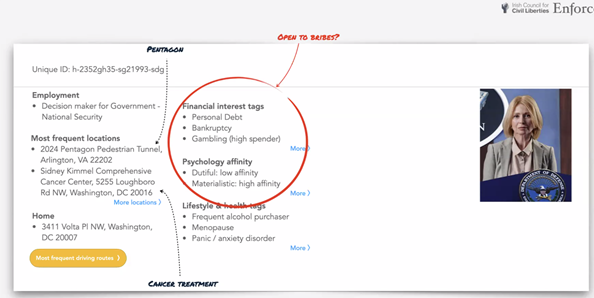
Ryan showed that some of the data points available in the marketplace through a process called Real Time Bidding have not only personal but national security implications. Information he was able to see—that data brokers can easily obtain—include whether you work for a government agency or for a company that builds systems or products for the government. Data is also available about your financial status—debts, child support owed, etc. A bad actor with both those data sets or other potentially embarrassing or compromising information might have leverage over an individual they wish to blackmail in exchange for sensitive government information. Adding an additional layer of complexity to the already complicated real time bidding process is that many data brokers are individuals or companies based in China or Russia. 

He is presently advocating with the European Union to limit or eliminate the availability of this type of data on the open market.  


AI and large language models are here with privacy implications we should know about. 

Jay Averitt, a Senior Privacy Product Manager at Microsoft, and Saima Fancy, Senior Privacy Specialist at Ontario Health, shared their perspectives about privacy implications in the new world of AI.  

They touched on the speed with which Large Language Models (LLMs) have appeared on the scene. Averitt said that they have just come in a whirlwind and that data privacy is a huge issue with the amount of data going into these models. Fancy posited that LLMs are being released prematurely. “There is a lot of hallucination in the output. In the health sector, people are putting personal information into it not realizing that the data will sit with the LLM and will be used for further LLM training. We have not had time to educate people because they are coming out rapid fire,” she added.  
 
Averitt noted that social media poses an interesting set of issues and there is a tradeoff. “Maybe you don’t have to have absolute privacy because there are some good aspects to social networks. It can be about striking a balance. How much privacy do you want to give up for the product?” he said.  

Fancy echoed those sentiments and added that everyone should recognize that privacy is a fundamental human right you need to protect. “Even if there is some info available about you already, you don’t need to add more. Be your own advocate. Balance your interests with the interests of your family. We don’t have to open our entire book, she explained.” 

Averitt and Fancy also discussed how we must come up with solutions to protect data being shared with LLMs. “Maybe we ensure we are not storing the prompts or training the models? If that model needs that data, we should use anonymized data to train it,” Averitt suggested. 

Fancy pointed to the EU’s General Data Protection Regulation (GDPR) as an example for privacy protection. “GDPR allows individuals to reject being subjected to automatic decision making. North America needs something like GDPR,” she explained.  

Averitt agreed and mentioned that we are playing catch up in the U.S. “I look at whether we are collecting data the right way, storing it the right way. It is about poor data collection in the AI space. It would be great if the AI boom would help get a federal privacy stature in place in the U.S.,” he said.


The more we know about what happens with our data, the more power we can have over it and its use. Here are takeaways you can use to actively engage with data privacy.

  • Personal – Your data is up for auction over and over.  
    Familiarize yourself with how and when your personal data is used by companies and organizations you interact with online. Understand the tradeoffs involved in these interactions. By sharing certain data, you may be giving up some privacy for the sake of convenience.  
  • Professional – AI is here and it is changing at a pace that U.S. privacy regulations have not matched.  
    Baking privacy into AI programs upfront will enable and improve both the AI program and individual’s privacy.  Until then, either avoid adding your personal data into AI systems or make informed decisions about the data you do share. Ensure you have the authority to use AI for sensitive or high-risk data, especially personally identifiable and health information that is not your own. These systems use the data they receive to train on. More dialogue is needed in higher education about best practices with AI and how it can beneficially assist individuals in their learning goals while maintaining privacy principles.  
     
  • Privacy professionals and researchers are your advocates for better transparency and trust.  
    Privacy at Illinois aims to make data privacy top of mind. As software and AI investments come up for purchase and review, the privacy team encourages vendors and developers to take a privacy is baked into the product and process approach. 

    Privacy engineering envisions privacy as a competitive and strategic advantage to drive true innovation in a digital and data driven world. Privacy engineering incorporates technical design and architectural privacy into software development, data projects, and technology. It vastly increases protection of private and personal information – often by not collecting personal details or by highly limiting how sensitive/personal information is collected, processed, stored, and used. 

    Thinking strategically about data management can make data available that previously might not be, but in a principled way. Learn more about privacy policies and practices and how Illinois privacy professionals can help with in your work at Illinois. 

Why Should You Care About Your Personal Data?

Page Metadata

Audience

Difficulty

From 1 to 10, 1 being easiest.
5
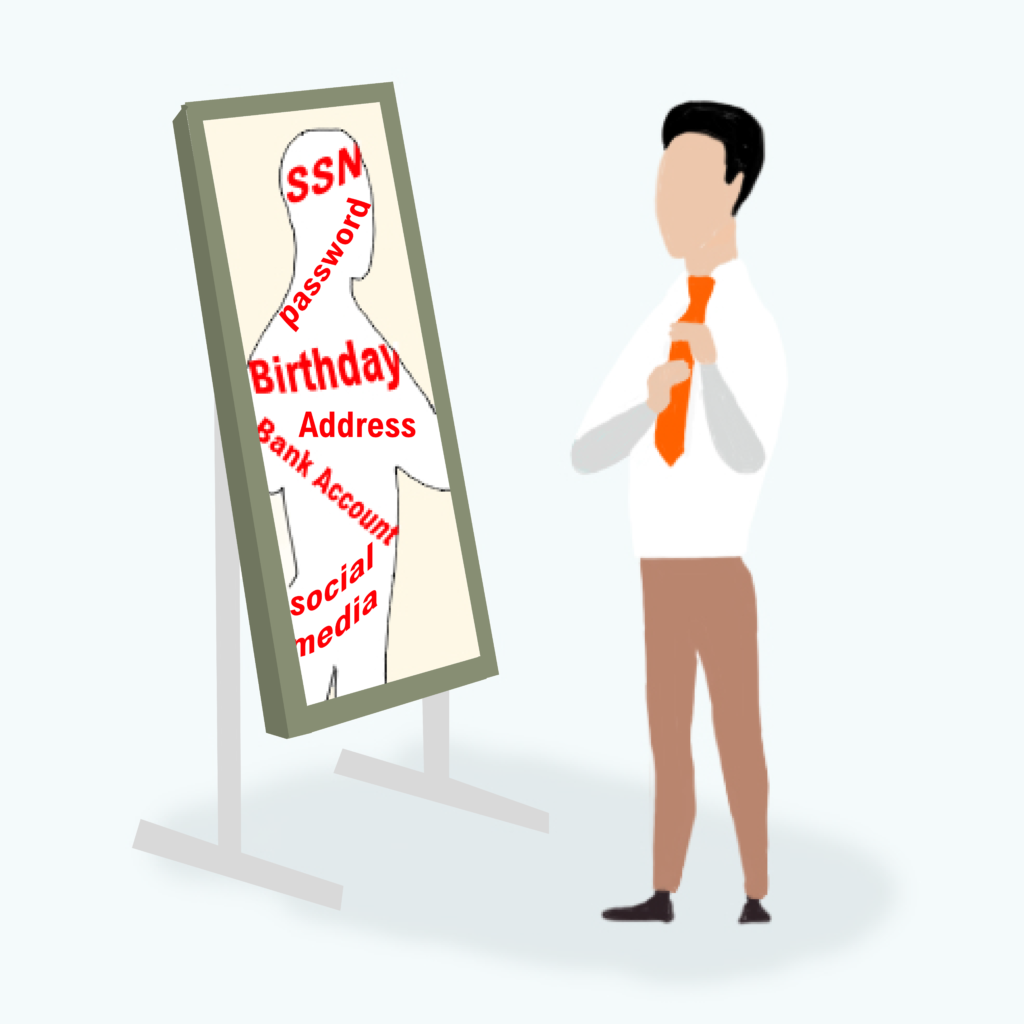
Man in front of a mirror and in his reflection, he sees data points about himself such as passwords, Social Security Number, social media, birthday.

Your data represents you. It is made up of snippets of information about you–everything from your location to your interests to your finances. Ultimately, this data can be aggregated to create a clear picture of your behaviors and beliefs and used in unexpected ways to inform decisions.

The University of Illinois takes steps to protect the data you have shared and created in the course of your time as a student, faculty member, researcher, or employee.

Technology Services is helping to lead University efforts to develop and define privacy policy. A set of privacy pillars guides the work.

  • Trust – Individuals should be able to trust that the university handles their data with the utmost care and protection. 
  • Transparency – Individuals should be notified and understand how the University collects personal data, and for what processing purpose(s) the data is collected. 
  • Consent – Individuals should be able to freely consent or withdraw consent wherever practical, and especially when consent is used as the legal basis for collecting and processing personal data. 

These guidelines also can help you as you consider your data privacy outside the university. Making informed decisions about your data is a key way you can safeguard your privacy, according to Associate Director of Privacy Phil Reiter. He explained that when you interact with an organization or business you can ask yourself some key questions:

Do they provide clear and understandable information about how your data is collected, processed, and shared? For example, do you know what they will do with your data and why they want it in the first place? Are you able to ask that your data be removed or that they stop collecting it if you change your mind about sharing?

According to Reiter, the European Union takes a human-centered approach in this space. As one example, you may have heard about some of the privacy rights available to residents of other countries, such as the right to be forgotten, where you have the right to request your data be deleted, and the law says the organization keeping the data must comply with your request.

“We’re seeing an emergence of comprehensive privacy law here, but often at the state level. The U.S. also focuses on sectoral law, like the health sector or financial sector, rather than comprehensive privacy law. This can lead to complexity and a patchwork that leaves large gaps or fails to mature overall privacy rights,” Reiter said.

What can you do in the meantime? Reiter suggests that while it may seem cumbersome, your privacy is important enough to take time to know what you are agreeing to.

“So much of our lives is conducted online. It’s natural for us to want to use the most convenient app, website, or AI to make our lives easier. Balancing that convenience by being informed about the personal information the app or site collects about you is important. We must play an active and informed role in the data collected about us in order to make decisions in our own interest,” he suggested.

Where can you learn more?

The University has information about privacy that includes a growing privacy guide to university data that provides information about how your data is collected and used. See it here: Privacy Guide to University Data

Privacy issues are complex and affect everyone. To learn more about the wider privacy landscape, Reiter and members of the privacy team suggest the following organizations:

Privacy & Cybersecurity
Digital Computer Lab
1304 W. Springfield Ave.
Urbana, IL 61801
Email: securitysupport@illinois.edu
Log In