Three privacy professionals conducting research in the library and information science space presented their current research related to privacy in the library.
by Ruth Kwak
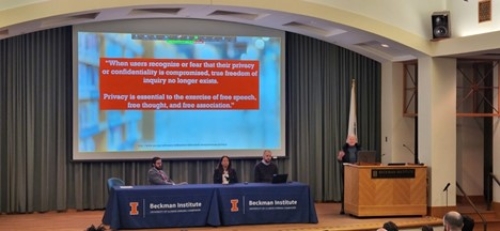
Eager professionals and students gathered in person and online on January 27, 2023 for the 2023 Privacy Everywhere Conference: Building Digital Trust. Occurring annually, this conference covers a range of privacy topics, unpacking the university’s privacy goals and how they affect individuals. Attendees should leave the conference each year with a stronger understanding of privacy policies and how to build digital trust in all realms of life. The 2023 conference was no different.
This year’s conference covered a wide range of privacy topics, such as privacy generally in higher education, how the university protects against cybersecurity threats, China’s personal information protection law, and more. In addition to those talks, the conference included a panel that discussed privacy in specific sectors relevant to the university and beyond. Three privacy professionals conducting research in the library and information science space presented their current research and projects related to topics of privacy in the library.
Patron Privacy Protections in Public Libraries by Masooda Bashir
Dr. Masooda Bashir currently researches issues and topics related to Privacy, Security, and Trust in relation to digital information. One of her many research studies conducted in this space was focused specifically on privacy, security and trust in public libraries. She sought to understand what the current practices of patron privacy are in public libraries, and what challenges libraries currently face in protecting patron privacy. To do this, Masooda and her team conducted an online survey in 2020, pivoting quickly from in-person forums due to the pandemic. The survey respondents, made up of library admin, librarians, IT staff, supervisors, and other library staff identified that the most needed step to strengthen patron privacy in public libraries is more library employee training on patron privacy and increasing staff knowledge about privacy-enhancing technologies. Challenges to protecting patron privacy included lack of technical knowledge among library staff, lack of training, and inadequate funding or resources.
To learn more about this project, visit the project website or contact Masooda at mnb@illinois.edu.
Prioritizing Privacy – Professional Development Project with Libraries by Kyle Jones
Dr. Kyle Jones partnered with our university’s Lisa Janicke Hinchliffe and a research team to work on a three-year continuing education program (ending August 2023) aimed at training academic library practitioners to address privacy and other ethical implications associated with learning analytics and academic libraries. With Lisa, Kyle created an online, canvas-based, e-learning, asynchronous, cohort-model course informed by Quality Matters (QM) standards. The course contains six modules and includes materials such as lectures from the research team, readings/media, collaborative learning activities, and recorded interviews with privacy and learning analytics experts. Running for 3 semesters so far, 99% of surveyed participants agreed that they learned important skills they didn’t know from before the course, and 100% agreed that they will use the information they learned. On a 5 point scale, there was also a point and a half jump in knowledge in a pre-course assessment compared to a post-course assessment.
Although the project ends in August 2023, the course materials are already made accessible—and will remain so indefinitely–for anyone to use for professional development via Canvas or other learning management systems. Kyle is also currently modifying the course to potentially be used for the LIS/iSchool curricula.
For more information, visit their project website or contact the research team at team@prioritizingprivacy.org.
Contracting for Privacy in Library Licensing by Lisa Janicke Hinchliffe
Professor Lisa Janicke Hinchliffe presented specifically on privacy in library licensing. Although libraries buy and license a lot of materials, often the contracts between the library and the vendor don’t cover how user data is handled. Additionally, when the contracts do include issues related to privacy, often they aren’t up to library values and expectations. To address this, Lisa began the Licensing Privacy Project. She wanted to figure out if the university can have more agency over what happens to their users’ data in the hands of vendors.
For The Licensing Privacy Project, Lisa worked with LDH Consulting Services to create a vendor contract and policy rubric to help libraries look for privacy concerns in vendor contracts and empower them to pursue better privacy practices. The rubric contains 8 privacy domains (data collection, user data rights, data disclosure, data processing, privacy policy, data ownership, user surveillance, data security and accountability), and 3 privacy levels (exceeds minimum viable privacy, meets minimum viable privacy, does not meet minimum viable privacy). The rubric is meant to be used as a guide for internal conversations and contract negotiations, to monitor whether vendors are changing practices, and can also be used as a training tool for library staff. Lisa is still in the process of learning how this rubric is currently being used to affect library contracting.
To learn more about the project, see the project website or contact Lisa at ljanicke@illinois.edu.